Most DTC brands are bleeding money on paid ads and don't even know it. They're running Meta and Google campaigns, seeing a 2x ROAS, and calling it a success — all while leaving 30–40% of their revenue potential completely untouched.
The problem isn't the ads. Ads are necessary. The problem is what happens, or doesn't happen, after the click.
This case study breaks down the exact funnel architecture that the most profitable DTC brands use in 2025: one where paid ads do one job only (top of funnel), and email owns everything below it — capturing, nurturing, converting, and retaining customers at a fraction of the cost.
Section 1:
Why Most DTC Brands Are Structured Wrong
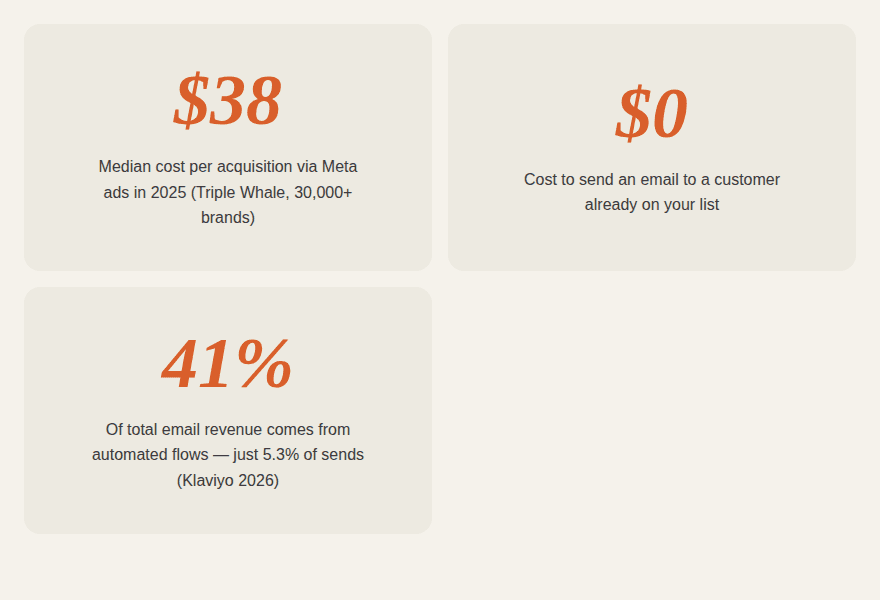
The average DTC brand in 2025 spends 68% of their total ad budget on Meta alone. That figure comes straight from Triple Whale's analysis of over 30,000 brands. Meanwhile, the median Meta ROAS sits at just 1.93x — meaning for every dollar spent, brands earn less than two back before accounting for product costs, fulfillment, and overheads.
The maths simply don't work if paid ads are doing all the heavy lifting. CAC via paid channels keeps rising. iOS signal loss has inflated apparent CPCs. And every repeat purchase that gets re-attributed to a retargeting ad is money wasted — that customer was already yours.
The brands winning in 2025 have figured this out. They use paid ads as an acquisition engine only — to get a stranger onto their list or to make a first purchase. Then email takes over completely. Every subsequent touchpoint, every repeat purchase, every upsell, every win-back: email.
Section 2:
The Three-Layer Funnel That Works
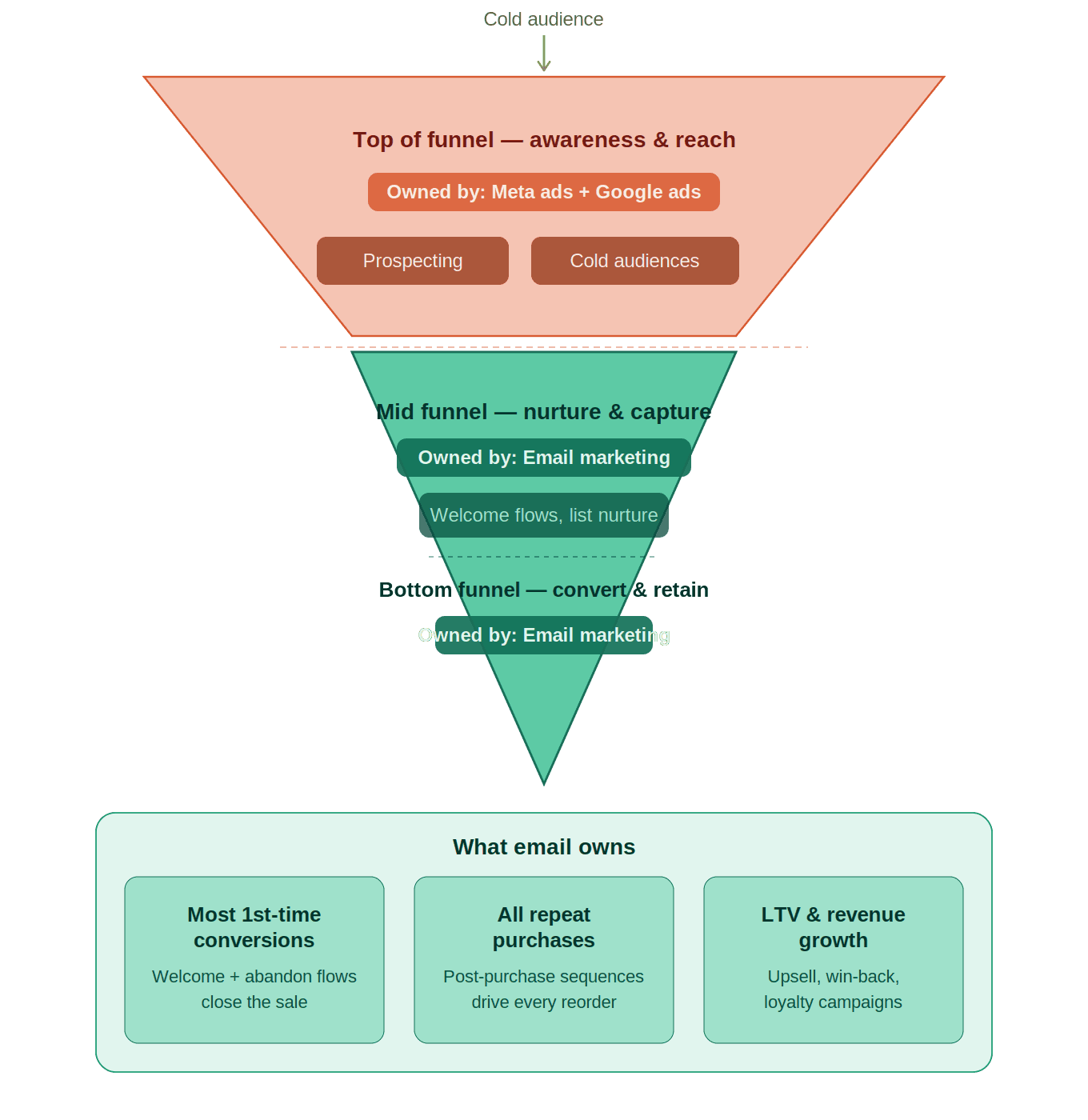
Layer 1: Top of Funnel: Meta Ads + Google Ads + Organic Socials
Paid ads have one job at the top of funnel: reach cold audiences and generate either a first purchase or an email opt-in. That's it. You are buying attention and data. Prospecting campaigns on Meta and Shopping campaigns on Google are your tools here. Every click should land on a page with a strong pop-up capturing email before the visitor bounces — converting 5%+ of cold traffic into owned contacts is achievable with the right offer.
Layer 2: Mid Funnel: Email Marketing
Here's what most brands miss: the mid funnel is not retargeting ads. It's email. Once someone has opted in or made a first purchase, the most expensive thing you can do is retarget them with paid media. You already own access to their inbox. Your welcome flow, browse abandonment sequence, and cart abandonment emails should be doing this work — at zero incremental ad cost.
Email flows generate nearly 41% of total email revenue from just 5.3% of sends, with average revenue per recipient nearly 18x higher than campaigns. That is the mid-funnel working as it should.
Layer 3: Bottom of Funnel: Email Marketing
Post-purchase, win-back, loyalty, upsell — all email. Nearly 48% of flow-driven email revenue comes from new buyers, compared to just 16% from campaigns, reinforcing the importance of welcome, browse, and abandonment flows for first-purchase conversion. Once someone converts, email is the only channel that makes economic sense for retention.
KLAVIYO DATA:
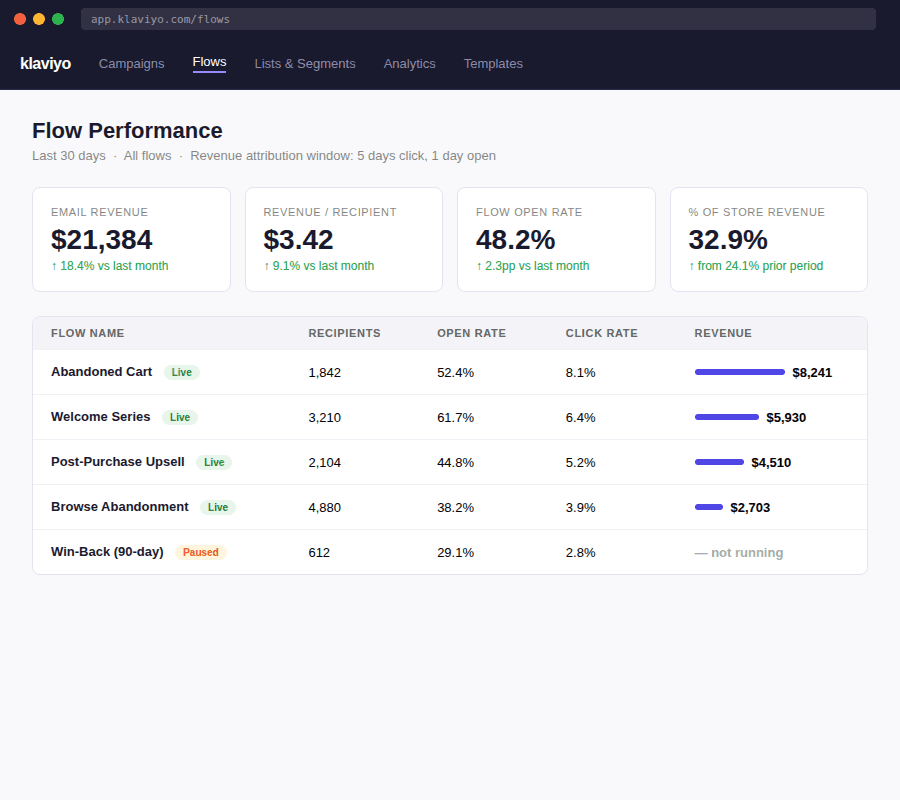
What This Looks Like Inside Klaviyo
Here's a representative Klaviyo flows dashboard for a DTC health & beauty brand doing $65k/month in revenue. Email is generating 32% of total store revenue — almost entirely from automated flows running in the background.
SHOPIFY ANALYTICS:
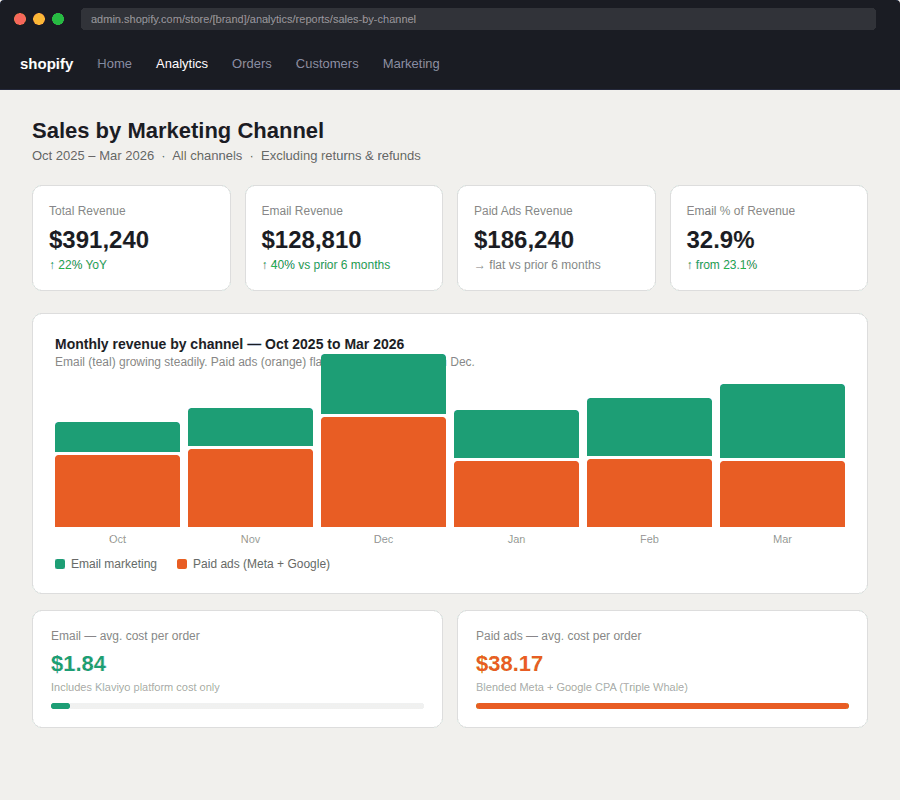
The Revenue Split: Ads vs Email Over 6 Months
What does this funnel look like in Shopify's analytics when you cut by channel? The chart below shows a brand that shifted their mid-funnel spend from retargeting ads to email over Q4 2025 and Q1 2026. Ad spend stayed flat. Email revenue grew 40%.
TRIPLE WHALE ATTRIBUTION:
The Full Attribution Picture in Triple Whale
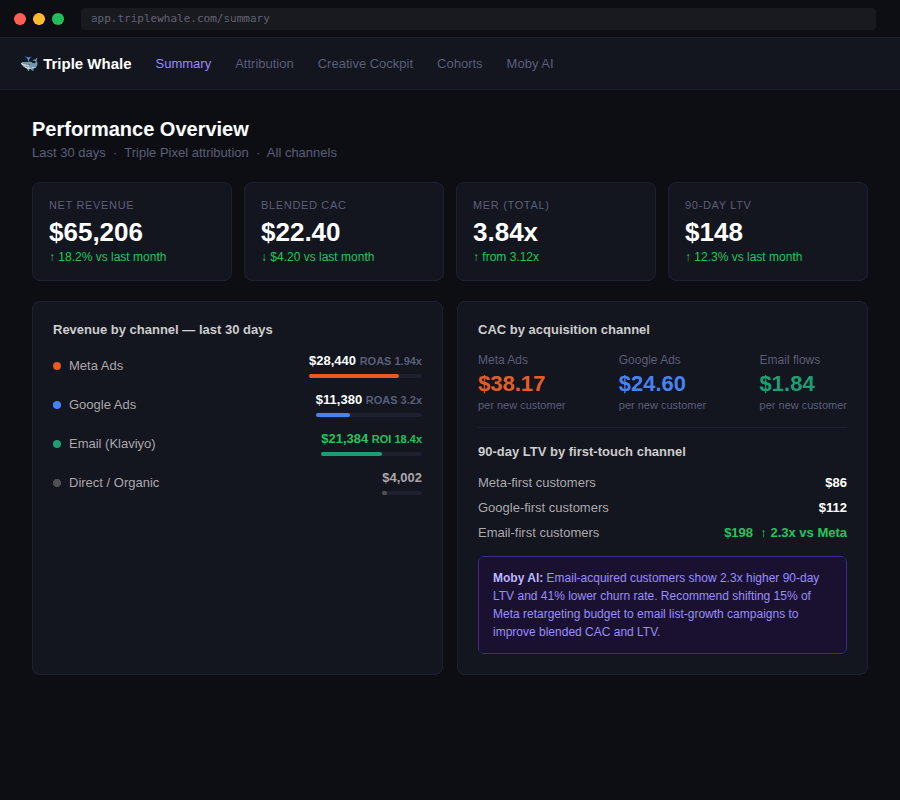
Klaviyo and Shopify tell part of the story. Triple Whale ties it together — showing true blended CAC, MER, and the LTV of customers acquired through each channel. The data below is what justifies doubling down on email: customers acquired via email flows have a 2.3x higher 90-day LTV than those acquired purely through paid ads.
THE PLAYBOOK:
How to Build This Funnel in 30 Days
Week 1: Fix the list capture
Your pop-up should convert at 5% or higher on cold traffic. Most brands are at 1–2%. A strong offer (10–15% off, or something genuinely useful like a quiz or guide), mobile-optimised design, and a two-step opt-in gets you there. Every visitor who doesn't buy should leave your site as an email subscriber.
Week 2: Build the four essential flows
Welcome series, abandoned cart, browse abandonment, and post-purchase. Abandoned cart flows boast 50–51% open rates and convert at about 3.3% on average — the highest conversion rate of any common flow — generating roughly $3.65 per recipient. These four flows alone, properly set up, should generate 15–20% of your total store revenue on autopilot.
Week 3: Kill the retargeting overlap
Turn off Meta retargeting for anyone who is in an active email flow. You are paying $38 CPAs to reach people you already have free access to in their inbox. This budget reallocation alone typically reduces blended CAC by 15–20% within 30 days.
Week 4: Add the win-back flow
Every customer who hasn't purchased in 60–90 days is a free revenue opportunity. A three-email win-back sequence with a time-limited offer recovers 5–12% of lapsed customers — at zero incremental ad spend.
The Funnel Math Is Simple
Meta CAC: $38. Email CAC: $1.84. Email-acquired customer LTV: 2.3x higher. The brands that understand this aren't spending less on ads — they're spending smarter. Ads buy the customer once. Email owns them forever.
Data sources: Klaviyo 2026 Benchmark Report, Triple Whale 2025 Ad Performance Report (30,000+ brands), industry averages for DTC health & beauty vertical.